

Two years ago, the personal website of art historian Lü Peng (luhistory.com) was officially launched. As an open and evolving academic platform, it takes time as its organizing thread, gradually accumulating and presenting Professor Lü’s research and curatorial practice in the field of modern and contemporary Chinese art.
In a context where information is often dispersed and versions are subject to constant change, the consolidation and continuous updating of existing research has itself become a necessary form of foundational work. The website emerged from this condition: not as a simple channel for information release, but as an attempt to provide a structure that can be revisited and used over time.
Over the past year, the site has undergone sustained development in both its academic content and core functionalities, gradually forming a clearer and more coherent structure. Professor Lü’s writings, research trajectories, and related projects have been systematically organized and updated. Among them, A History of Chinese Art in the 20th and 21st Century has been made fully available on the site, with complete open-access download, offering a more direct entry point for readers and researchers alike.
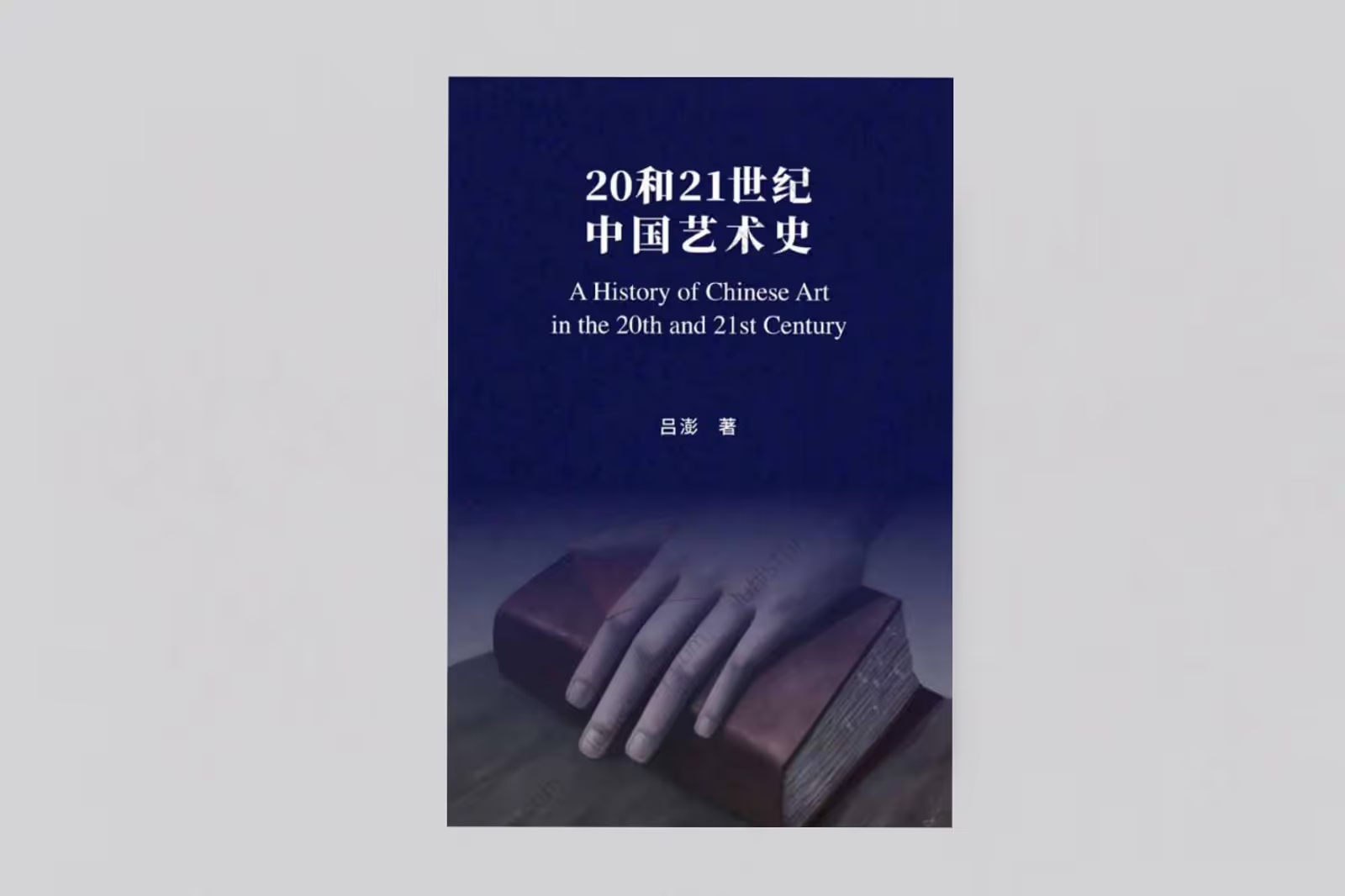
Download link:
https://luhistory.com/book/detail/a-history-of-chinese-art-in-the-20th-and-21st-century-chn/
As part of this year’s development, new video and archival sections have been introduced. Lectures, interviews, and related visual materials are now integrated into the platform, extending research beyond text-based formats. Meanwhile, the archival section continues to compile documents, records, and historical materials, providing a more fundamental layer of support for art historical inquiry. The website is not intended as a simple aggregation of information, but as an effort to establish traceable relationships across different types of content.
At the same time, the site’s usage has grown steadily. The highest number of daily visitors has exceeded 3,000. Users primarily come from the United States, United Kingdom, France, China, and Singapore, among other regions. They include not only researchers and writers, but also a broader audience with an interest in modern and contemporary Chinese art. Ongoing engagement across different contexts has gradually shaped the site into a transregional network of reading and research.
Two years mark only a provisional point.
Rather than a conclusion, it is the beginning of an ongoing accumulation.
Looking ahead, the website will continue to prioritize research, further advancing the systematic organization and open accessibility of its content. This includes the continued development of the archival section, the expansion of multilingual materials, and the gradual strengthening of connections with researchers and institutions. Through continuous updating and revision, the aim is to build a resource that can be revisited, used, and sustained over the long term.
Continuing forward.