

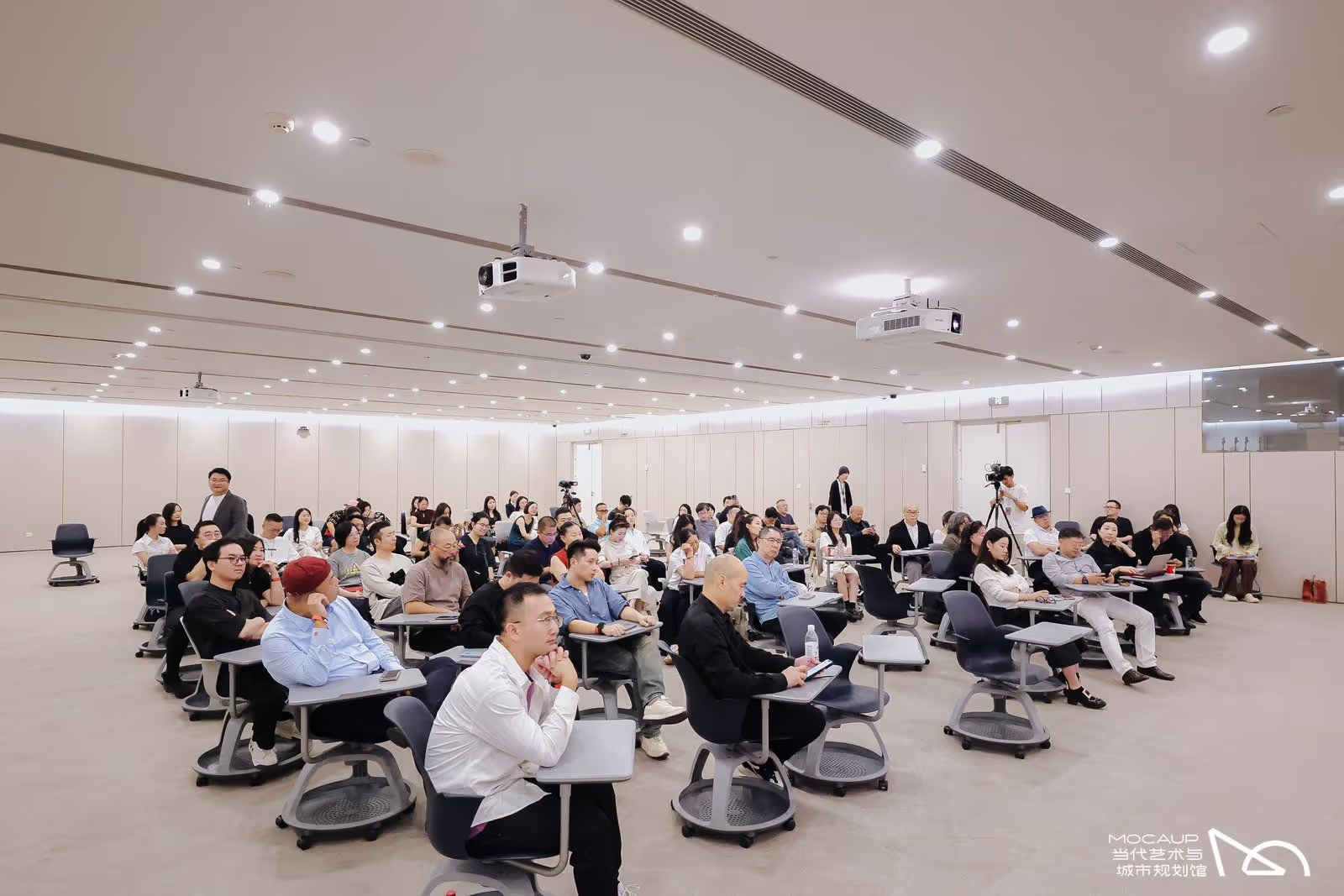
On the opening day of Reality, Surreality — A Major Exhibition of Contemporary Chinese Painting , MOCAUP curated two academic salons, inviting curators, art historians, and participating artists to engage in in-depth conversations on “contemporary Chinese painting.” These discussions not only extended the exhibition’s intellectual scope, but also offered a critical reflection on the current art ecology and a point of renewed departure.
Session I: The History and Present of Chinese Surrealist Painting
The first salon was moderated by curator and art historian Lü Peng , who traced the development of Chinese Surrealism from both historical and contemporary perspectives.
Opening with “A Thirty-Year Retrospective of Contemporary Chinese Art,” Lü Peng remarked: “The boom of the art market is long over, but art must continue to move forward.” He emphasized that Surrealism was not a sudden trend, but a sustained phenomenon shaped by the interplay of social life, historical accumulation, and artistic thought. In his view, the exhibition situates current practices within a historical framework, allowing a reassessment of the meaning and value of Surrealist visual language today.
Liu Chun , rotating chair of the 16th Annual Conference of Chinese Art Critics, proposed the development of “comparative art studies,” noting that the group exhibition format reopens fundamental questions in art history. He observed that Chinese Surrealism responds to reality through dreams, the magical, and strategies of defamiliarization. Yu Ke , professor and curator at the Sichuan Fine Arts Institute, reflected that Chinese Surrealism differs from its Western counterpart in cultural and psychological contexts; its core lies in constructing an alternative reality and mode of perception. Curator Duan Shaofeng pointed out that the work of a younger generation of artists demonstrates a sense of unreality and fragmentation; technology makes dreams visible, mirroring anxieties of the age.
Yan Weixin , Director of the Shenzhen Museum of Contemporary Art and Urban Planning, noted that Shenzhen itself bears “surreal” qualities: the city’s rapid transformation and the individual’s constant adjustment provide a unique context for artistic creation. In closing, Lu Peng concluded that such a distinctive social and urban environment gives Chinese Surrealism its vivid and singular character today.
Session II: Issues, Phenomena, and the Future of Contemporary Chinese Painting
The second salon, moderated by scholar Li Guohua , brought together participating artists to discuss the present condition and future directions of painting. The discussion suggested that no single term can fully describe today’s creative landscape. Each artist responds to the times in different ways: some articulate personal experience through an aesthetics of absurdity; others explore identity and social perception through theatrical staging or image-based strategies; still others draw on everyday life and transnational experience to construct distinctive narratives and psychological landscapes.
Technological development was another major topic. Artificial intelligence and virtual reality expand artists’ imaginative possibilities, while raising new challenges: how can narrative depth and the authenticity of individual experience be sustained within a digitalized and globalized context? The artists generally agreed that contemporary painting is not merely visual representation, but a medium for thinking about reality and for probing psychological and social conditions.
Surrealism continues to play a significant role in contemporary Chinese art. It reflects both the anxieties of the times and individual experience, while pushing the boundaries of language, form, and technology, offering viewers new ways to understand reality and the self.