

In late 1993, as the follow-up work for the Guangzhou Biennial came to a close, I headed to Shenzhen.In a special issue on art in the Border Trade News , I read an essay entitled “ Artists Return from VeniceDisappointed. ” The essay gave a basic introduction on the situation of the thirteen Chinese artists who took part in the Venice Biennale for the first time, and as the title suggests, these artists were perhaps less than pleased with their experience there: the installation time was too short, the exhibition space was very subpar, the accommodations were lousy, most of the artists had to pay for their own travel, Chinese representative Li Xianting had no opportunity to introduce Chinese art to the world, et cetera. At first, “Obtaining passports was easy, and there wasn’t any trouble applying for Italian visas, and so these not-so-famous artists withdrew most or all of their savings from bank and set off on a pilgrimage to this world art mecca with excitement in their hearts.” Their experience in Italy, however, did not live up to their rosy expectations. Though this essay was statement of a school, and could not provide more detailed information, we did not have any other material that suggests the artists who attended this large international art exhibition were either happy or satisfied.
To be sure, the essay was a bit satirical, and in fact, Chinese contemporary artists did not live nearly as easy twenty years ago as we would like to imagine. Not long before, due to the events of June 1989, many artists and critics left their homeland. Most of them perhaps believed that only by going to Western countries could they continue to develop in their respective fields. The artists and critics who remained in China did not revive their spirits for a long time. Though younger artists, such as Fang Lijun, and some of the more vibrant artists of the 85 New Wave Movement, such as Wang Guangyi, restored their definitive artistic practices relatively quickly, most artists continued to wallow in bitter meditations on the future of life and art. Here is what Zhang Xiaogang wrote in a letter to Zhou Chunya written in September 1989:
After returning to the academy, twenty days have passed in the blink of an eye, and it seems I haven’t done anything proper in all this time. I studied for a week, listening to papers and lectures every day until my butt ached and my head spun. Of course, in the end, I fail to escape from it. The secretary’s staff made a few requests and I said my piece, making it through smoothly. I think about you over at the painting institute; who knows how much more serious it is over there, no need to mention the Academy is being treated as a “major disaster zone.”
Those few short sentences present us with the basic political context of the time. By the logic of any normal person, leaving such an environment would be only natural. In a December letter to Mao Xuhui, however, Zhang Xiaogang leaves this record:
I got a letter from Yang imploring me to leave, and I plan to write back to tell him what I think. I think that, on the contrary, this is not the time to take flight, and it’s not about entering the “gypsy camp of Asia” either. Removed from the greater background of China, there is no “art” to speak of. As long as I can paint as I like, I will remain here…. The state I’m in these days feels a bit like returning to the past. I’m listening to Beethoven and Tchaikovsky, with El Greco by my side, not to mention Sartre and Unamuno.
Whether or not it was by choice, most people stayed, but as spring approached in 1992, a certain set of important modern artists, through constant pondering and provocative experimentation, was making the shift towards contemporary artistic practice. There is an instinct towards struggle in life, and when reason is added to the mix, life can still create miracles. In fact, around the year of 1990, though modern artists had no exhibition opportunities, another kind of release that was spreading through social life—the potential of the consumer market—gave artists a new opportunity to continue their work. In a June 1996 letter, Wang Guangyi writes:
China is stuck in a war of words over the meaning of art, but this is pointless. From the absolute perspective of contemporary mechanisms, only substantive success is real. Otherwise, no matter what we say to them, we are doing nothing more than establishing the so called illusory satisfaction of the cultured.
…Yet we also possess the ability to create “concrete myths,” just like the “snowball” ability we were talking about in Beijing. What matters is that we must ensure that this “snowball” truly happens, that it becomes a thing that the masses can perceive and puzzle over! If we do not make a big snowball, then perhaps others will make big snowballs. Perhaps the 1990s only needs a few snowballs. There’s plenty of “snow” on the ground, and we’ve got “stones” in our hands.Now we must actively roll up our snowball! Perhaps the times and history can only give us this one chance, and if we miss it, we will regret it forever!
In the spring of 1991, a strategic magazine was published under the title Art & Market . The first issue was onWang Guangyi, and in answering a series of questions from the editor, he said:
At present, Chinese contemporary art has not gained a status commensurate with the academic levels it has attained. The reasons behind this are quite complex, but one main reason is that there is not a powerful national bloc to back it up. The success of postwar American art is actually the success of the national bloc. Otherwise, artists such as Jackson Pollock, Willem de Kooning andJasper Johns would not be what they are today. You used the term “art industry,” and that is avery good term. It touches on an issue of circulation. I think that we must first take part in this circulation if we are to be significant on this track. We have already begun taking part now, and I would predict that in five years, China’s “products” will be playing a decisive role in the world art industry.
At that time, no one could have imagined the fate that was in store for Chinese contemporary art in the“world art industry” five years down the road, but through the efforts and liaisons of Kong Changan, we spent over CNY 30,000 to invite Flash Art editor Francesco Bonami to the “Guangzhou Biennial” held at the Guangzhou Central Hotel in October 1992, in hopes that international society could learn about localChinese contemporary art. In that year, Wang Guangyi’s Great Criticism: Coca-Cola was featured on the cover of Flash Art (Jan-Feb 1992, volume 162), and I placed an advertisement for the Guangzhou Biennial in the same issue.
In fact, Chinese art critics were already making efforts to promote international understanding of Chinese modern and contemporary art at that time. Before June 1993, Chinese artists and critics were taking part in many art exhibitions. In 1987, Zheng Shengtian, Huang Youkui, Dai Hengyang and Shen Roujian were featured in Beyond the Open Door: Contemporary Paintings from the People’s Republic of China at the Pacific Asia Museum in Pasadena, California; in 1989, Fei Dawei curated Chine demain Pour Hierr in Pourrières, France, and assisted Jean-Hubert Martin in organizing Magiciens de la Terre in Paris; in 1991, Leo Ou-Fan Lee and Zheng Shengtian worked with the Pacific Asia Museum to create the exhibition I Don’t Want to Play Cards with Cezanne and Other Works: Selections from the Chinese NewWave and Avant-Garde Art of The Eighties ; in 1992, Hanart TZ Gallery took part in a satellite exhibition at Kassel documenta, and Kong Changan helped put together Cocart Bevete Arte Contemporanea in Milan; in early 1993, Andreas Schmid helped organize the China Avant-Garde exhibition in Berlin, whileLi Xianting, Johnson Chang curated After 89: New Art from China in Hong Kong and Mao Goes Pop in Sydney. Domestically, historically important exhibitions organized by Westerners included the Liu Wei solo exhibition that Francesca dal Lago held in her home in 1990, as well as the exhibition of works by Liu Weiand Fang Lijun that she held at the Beijing Art Museum; meanwhile, the Beijing Diplomatic Staff Club held the exhibition Recent Works—Paintings and Installations by Zhang Peili and Geng Jianyi in 1992.
Nevertheless, as the Cold War drew to a close and the world entered into the post-Cold War era, the influence of Chinese contemporary art in the international community was infinitesimal for a long time, even through 1993. At that time, artists in China had few opportunities to exhibit their works, let alone sell them, and at my urging, Wang Guangyi and Zhang Peili sold some of their important works for very little money to a friend of mine who had started a company. Before June 1993, no one had a clear picture of what they thought would come in the future, but they did have faith in art. The ideas, content and expressive forms ofChinese contemporary artists, however, were completely incompatible with the demands of the official state art apparatus. Though Gao Minglu and other critics were able to hold the China / Avant-Garde exhibition at the National Art Museum of China in February 1989, this last hurrah of 1980s modernism did not imply a change in official standards for art, let alone the birth of a new art system.
Afterwards, modern and contemporary art would have a hard time entering into this shrine to the national arts. It was under these circumstances that community-based elements of society began their support for contemporary art. The Guangzhou Biennial became a reality through the reaffirmed legitimacy of the market economy and through community support. After Deng Xiaoping’s “Southern Tour” of 1992, anyone with a hint of political sensitivity could see that the market economy was clearly transforming this national art system. While official art organizations were wholly unsupportive of contemporary art, the market, through its basic nature and functions, began the construction of a new art system, except that when the market first began to intervene in art, most people did not take notice of this decisive event. In fact, I pointed this out in the foreword to the Guangzhou Biennial:
This “biennial exhibition” is unlike any other past exhibition in Mainland China. In terms of economic backing, the “sponsorship” of the past has been replaced by “investment”; in terms of operations, the cultural organization of the past has been replaced by a company; in terms of process, the administrative “notices” of the past have been replaced by legally binding contracts; in terms of academic underpinnings, the old ad hoc, artist-run “artwork selection teams” have been replaced by jury committees run by art critics; in terms of goals, the old monolithic, narrow and always argumentative goal of artistic “success” has been replaced by efforts towards comprehensive economic, social and academic “effectiveness”…
The increasing penetration of the reform and opening policy has brought new changes to the methods of history composition. As the old standards have become unsuited to the needs of a new era, the importance of a new standard is becoming increasingly apparent. The central implication of the new standard is that culture must be produced for sale, a tenet directly aimed at the classical model of “culture created for the sake of culture.” This is in complete opposition to the old cultural production models of “self-indulgence” or political utility: it requires the support of a series of contemporary market mechanisms such as laws, taxation, insurance and the further division of labor. For a country with no market traditions, this is truly an immense and complexundertaking, and the participants of this biennial exhibition—entrepreneurs, critics, artists, editors,even lawyers and reporters—have begun the task of confirmation and explanation required for theestablishment of the contemporary art market through their participation. Now, more people areclear in the understanding that in the 1990s, the question of the market is a question of culture.
To be sure, due to the rules of circulation and value exchange in the market economy, the contemporary artists who were unable to gain official organizational support at home met the necessary conditions to be brought into the international community by Westerners (including Johnson Chang, who lived under the capitalist system in Hong Kong). Those Chinese artists who already lived and worked in the capitalist countries of Europe and America, such as Huang Yongping, Xu Bing, Gu Wenda, and others who emerged later such as Cai Guoqiang, also strove within their own unique contexts to take part in international exhibitions and became immersed, to varying extents, into international art circles. Over a period of time, art critics such as Hou Hanru and Fei Dawei, well versed in the rules of the game in the West, gradually gained the status of “international curators,” and whenever they had a chance, strove to insert new Chinese art into international exhibitions, placing it directly in exhibitions such as the Venice Biennale.
Regardless of people’s views on Chinese artists’ participation in the Venice Biennale, it was in fact the participation of everyone who cares about Chinese contemporary art that gradually led to the world’s awareness of Chinese contemporary art. More importantly, events, money and influence will change people’s views about Chinese contemporary art: in 2000, the Shanghai Biennial began using a curatorial system that approached the ones used in the West, and many Western artists took part in this exhibition; by2003, the Venice Biennale had a China pavilion, and though the presence of Chinese contemporary art atVenice was affected by the SARS epidemic, the establishment of this pavilion demonstrated that official state art organizations had begun utilizing Chinese contemporary art in their strategies. The legitimacy of Chinese contemporary art arose against this backdrop.
Moreover, while Chinese contemporary art still lacked the legitimacy of systemic protection, people came to discover the serious influence of the market over art, and began to grow skeptical of Chinese contemporary art in the market. Criticism of the relationship between Chinese contemporary art and the market was also raised by certain Westerners at the same time. All of these critics should know, however, that sales, capital and profit have been chasing the tail of the Venice Biennale since its first installment. Except for the “storm” of anti-capitalist sentiment and protest that swept through several European countries in 1968, capital and the market have never left art. In addition, the question of the market has special circumstances in China—since the 1990s, the only support for Chinese contemporary art has come from the market and the international resources that it brought. Due to certain complex political factors, Chinese contemporary art is still far from establishing a scientific market system, and fundamental changes have yet to take place in the Chinese art system. Authority in the art field has not seen rational application because of the emergence of the market; to the contrary, the abuse of authority and crude market games have together produced the conundrum that Chinese contemporary art faces today both at home and abroad. Since the effects of the economic crisis first became apparent in 2008, the fate of Chinese contemporary art has always been on everyone’s minds: how should Chinese contemporary art develop?
As I see it, artistic creation—antiquated as this term may be—is always a question for artists, When it comes to us critics, curators or historians, we can engage in reflection, rearrangement and evaluation one very thing in the past artistic trajectory. The artists and critics who have participated in the Venice Biennale have been full of anxiety, stress and questions, but I also believe that the artists and critics who have taken part in this biennale also have unforgettable perceptions and stories, and it is through these perceptions and stories that our history of the event is constructed. Moreover, the global “historical passage” that began in1993 was not only Chinese contemporary art history but an integral component of global art history.
One day in 2011, Richard Widmer, an American who has lived in China for many years and deeply understands Chinese contemporary art, sought me out at Café Copy in Beijing. He said that he wanted to do a research project on the Chinese artists who attended the Venice Biennale, and needed funding (roughly400,000 CNY). I agreed without hesitation. When I returned to Chengdu, I worked out an idea: wouldn’t it be more complete if we held a retrospective on the historical exhibition of Chinese artists at Venice, combining historical documents with their recent works? As a result, Chengdu Museum of ContemporaryArt provided one million CNY in funding to collect the relevant historical material and research work for publication. At a time when there are many exhibitions every single day (while in the past, for instance in1995, there were very few opportunities for the exhibition of modern and contemporary Chinese art; in 1996, Huang Zhuan planned a valuable contemporary art exhibition at the National Art Museum of China, entitledFirst Contemporary Art Academic Invitational, but it was forced to shut its doors on the eve of the opening),the older generation of critics are stepping back from the center stage of history, while most new young critics are becoming curators, as immense economic pressure makes it difficult for them to promote academic research. Of course, research on contemporary art still rarely gains support from official art organizations, and this situation forces us to continue seeking strength from the community so that we can prepare the basic material that will be needed by future art historians. I have already completed 90s Art China 1990-1999 (published in 2000), and in the spring of 2012, A History of Chinese Contemporary Art in the 21st Century 2000-2010 (published in 2012), and the composition of these two art history texts has made me acutely aware that the twenty years of Chinese contemporary art history must be researched from multiple angles. And so, at this time when the entire contemporary art scene is engaged in reflection and retrospection, I think that the twenty year history (1993-2013) of Chinese artists participating in the Venice Biennale is an important angle for historical research.
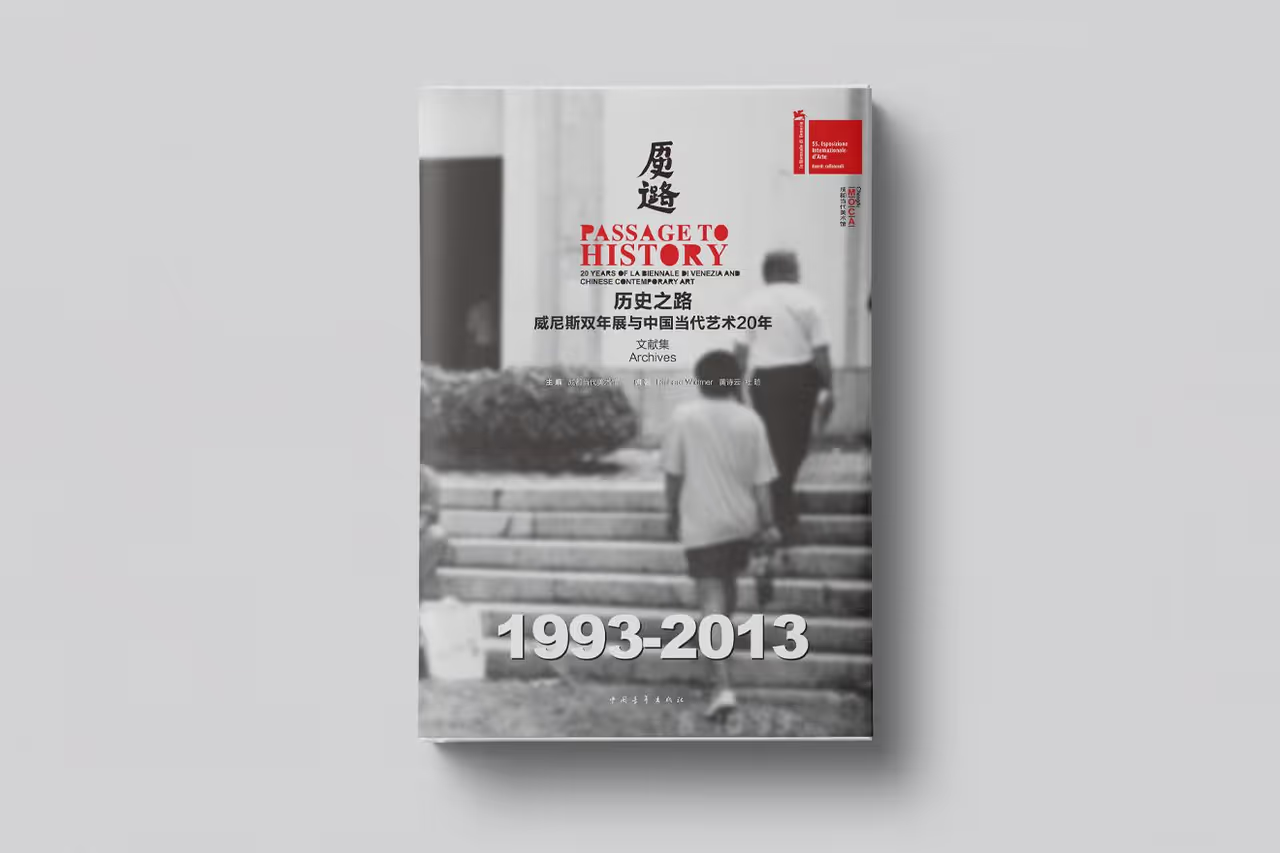
For most of 2012, Richard Widmer and his assistant Huang Shiyun traveled to many cities, visiting nearly all of the artists who have participated in the Venice Biennale over the years. This work has provided us with primary material on those artists and their participation in the biennale, which is now being published under the title Passage to History: 20 Years of the Venice Biennale and Chinese Contemporary Art(Interviews) . The book brings together interviews of over 70 artists and other participants who have taken part in the exhibitions, as well as documents pertaining to Chinese contemporary art and the Venice Biennale since 1993, providing the reader with a rich trove of materials. Meanwhile, many historical documents provide us with photographs and sketches pertaining to this period of history. When we read about the pastthoughts and experiences of these artists through these textual and visual materials, it is hard to contain ouremotions. Through the careful compilation carried out by Widmer and his team, we have also publisheda catalogue rich with images. Actually, after reading these materials, we can clearly see that it was the combined efforts of Chinese contemporary artists and critics at home and abroad, as well as those Western curators with a passion for art that made this precious period of Chinese contemporary art history possible.In order that today’s readers and viewers can quickly gain an understanding of the history of Chinese artists at the Venice Biennale and learn about the historical nature and role of the Venice Biennale. I have asked China Academy of Art graduate student Wang Yang to compose Passage to History: 20 Years of the VeniceBiennale and Chinese Contemporary Art , aimed at younger readers in order to inspire them to research and pay attention to Chinese contemporary art. In this era flooded with material desire, as history prepares to turn a new page, the research of past history by young researchers is both necessary and highly significant. Of course, we have also compiled and published a catalogue for this exhibition. Many of the artists included in this exhibition have attended past installments of the Venice Biennale, but we have also selected a few who have not. We have also selected one young artist to take part in this exhibition to show that Chinese contemporary art must be both rooted in the past and facing the future in a continuous line of development.
Unlike previous Venice Biennale exhibitions, this exhibition will be presented simultaneously in bothVenice and Chengdu. The Venice space will be at the Arsenale, Nappa N.89 and the Chengdu space will beat the Chengdu Museum of Contemporary Art. There are several reasons for this decision. The first is the hope that the Chengdu residents who are unable to travel to Venice can see the Passage to History exhibition for themselves and gain a synchronous understanding of the historical information. Chengdu MOCA’s act of bringing leading Chinese contemporary artists to the Venice Biennale is an important cultural event for the city, and we of course must try our best to allow the people of Chengdu to take part. Second, the“Passage to History” is not merely the historical progression of Chinese contemporary artists at Venice but the historical progression of Chinese art taking part in the composition of global art history, and we can reexamine this controversial and uniquely valuable history from a new perspective. Chengdu is a city with rich contemporary art traditions that provides the proper climate for the presentation of this “Passage to History” exhibition. Third, the year 2013 will see the sixth installment of the Chengdu Biennale, and I hope that the warmth of the Venice Biennale, which opens in June, can be carried on in Chengdu, serving as an artistic and historical wellspring for this year’s Chengdu Biennale. In September 2011, Venice Deputy Mayor Tiziana Agostini travelled to Chengdu and praised the fifth Chengdu Biennale, and the year 2013 should be a good opportunity to further promote the cultural and artistic exchange for these two cities, so the establishment of an exhibition venue in Chengdu will help to promote this exchange. Coincidentally, the opening of the “Passage to History” exhibition in Chengdu will coincide with the commencement of theFortune Global Forum in Chengdu, and global economic and political leaders will have a chance to learn about the international character of this city: internationally influential artists and an exhibition will provide attendees with artworks of the highest artistic caliber, clearly providing much spiritual wealth to these people who have come to discuss the material wealth of nations. And, in a touch that I’m sure will prove interesting, we have created a visual channel for live interaction between the Venice and Chengdu venues, so that audiences in both places can see the same exhibition taking place in two locations in different countries and have the chance for a broader exchange.
Finally, I would like to thank Achille Bonito Oliva. In bringing Chinese contemporary art to Venice in 1993, he got the world interested in Chinese art and the destiny that stands behind it. I spoke to Oliva in early spring 2012, saying, “When you first brought Chinese art to Venice, it had a huge impact in China.Some Chinese critics chimed, ‘Oliva is not the savior of Chinese art.’ How do you feel about that?” Here plied, “Of course, I’m just an Italian who loves art.” This left a deep impression on me. We reached an agreement to co-curate Passage to History: 20 Years of the Venice Biennale and Chinese ContemporaryArt , and agreed to each write an essay, no less than five pages long, commemorating this period of history. I would also like to thank Paolo de Grandis. The assistance of his organization smoothed the path for this exhibition. In addition, I would like to thank the staff of the Chengdu Museum of Contemporary Art and all other members of the team. It would be difficult to imagine such a comprehensive and professional exhibition and publication without their dedicated efforts.
February 11, 2013
Fairy Tree Courtyard, Chengdu